Showing posts with label Agritourism. Show all posts

Friday, July 12, 2013

Adventurous Times

I often use the phrase "never a dull moment" when referring to my life back home both on the farm and while at school. That phrase has definitely transferred into my work life as well! Which is good, because it keeps me on my feet and excited about the next day.

Telling sponsors what the first hand experience has been like
This week at the Pig Adventure, we held an event for all the industry donors who have given financial support to help take the Pig Adventure from a dream to a reality. That event meant that people from all over the pig industry gathered in Fair Oaks, IN to hear get the official tour of the Pig Adventure.


Many people came to see specific things, but everyone was interested in hearing what we had learned about the perception of modern day pig farms from our regular visitors. I took great delight in being able to answer those questions, and used that time to tell people what I had noticed. My previous blog post eludes to many of the things I feel to be true about what I am seeing on a daily basis.

We are also finishing our second week of being open to public tours this week and I am proud to say that in the past ten day, more than 7,000 people have come through the doors of the Pig Adventure and seen first-hand what happens inside a modern day pig farm.

It has been great to see all of these pieces come together on the agri-tourism side of my adventure this summer. I am so happy to be a part of the many great things to be coming for the Fair Oaks family as well. I really can't wait to see what the next week will bring as there is always something exciting and interesting going on.

Friday, July 5, 2013

Farmers Need to Shine, Don't Fight the Shadow

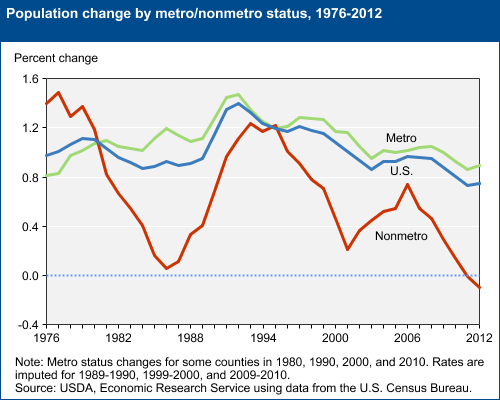
According to the United States Census Bureau, there are roughly 300 million people living in the United States. Of those, only 15 percent live in what the United States Department of Agriculture (USDA) describes as non-metro areas or counties. And when you look at the change and trend in the numbers indicates on a broad level that people are continuing to leave the non-metro areas in the long run. Growth may come and go, but the distance between the rural and metro consumers of our country are growing.

Graph from USDA website: http://1.usa.gov/1bbRmnB
There is a lot of rhetoric in agriculture about the growing disconnect between gate and plate, farm and food, and the understanding of common farm practices. In part to my internship this summer (which can be read about in previous blog posts), I have realized a few things about how farmers react to the proactive approach that the industry has began to take in order to reconnect consumers with the farms of modern day agriculture. 

In my opinion, farmers are all to often "afraid of their shadow" when trying to talk with consumers who don't have an agriculture background. Occasionally some retired pig farmers will come through the Pig Adventure and they always have memories of the "old days" and "how it used to be". Many offer encouraging words about what we are doing, but some will raise their concerns with transparency. 

Some farmers (all different ages) that I talk with, seem to think that their is a limit to transparency. That we need to "tread lightly" or else we are going to get sunk in hole we can't dig out of. This is where I believe that they are "hiding in their shadow" and not willing to be honest about the practices on the farm. I believe that this is because as an industry, we have underestimated human nature and the one's ability to listen to farmers without jumping down their throats. 

It seems to me that if you have a product (pig farm, crops, dairy, beef, poultry etc) that you are proud of, invested in, and willing to talk to openly about; then 99 percent of the people you talk to are interested and willing to listen to you before forming an opinion about your product and processes. Sometimes people have an negative idea of what you do on the farm because of some propaganda they saw that was sourced by someone opposing agriculture. But even then, people tend to be amazed at the processes of farming and are able to connect with the simplicity that we still have on the farm. Even though we are using technology to find that simplicity.
I'm giving a tour of our breeding operation to a group of friends. Bio security measures require them to wear the disposable suit when in the barns.


My boss asked me the other day, "if a farmer could have a five minute conversation about agriculture and show them an aspect of what they do, could we (agriculture) change the opinion of many people who unknowingly follow the propaganda and form negative feelings towards agriculture?"

I believe that the answer is yes! While I know I it can't be done alone, I believe that their is a special way for agriculture to have these friendly conversations that can mean a world of change for our industry. I want to offer a few reminders for those who want to have these conversations:

  1. Don't be afraid of your shadow - Shadows are only present because their is light shining on us, the time for us to step into that light is now. Bigger shadows mean more light on you! Take advantage of the opportunity present.
  2. Talk about what you do - People want to talk to people. They want to know that you're a farmer and that you care about them. The more personable you can make your conversation, the more they will listen to what you have to say.
  3. Be comfortable with the uncomfortable - many times we begin to talk about what we do, then when a negative term or question arises, we quickly run back into the shadow. No wonder people are afraid of agriculture, if we aren't willing to talk about it ourselves!
  4. Enjoy yourself!! - People want to see you happy and excited to talk about what you do. The light has never shined brighter on agriculture than it does now. I'm proud of what I do and I want to show others why! That is the thought that makes the whole idea of talking to others a bit more comfortable to me. 
Hopefully these words encourage some to begin taking those steps out of the shadows. If you are worried about the response you're going to get, just wait until you see people's faces light up when you show them the farm. I encourage all farmers I talk to, to find a way to have these conversations, through trainings, social media, tours, presentations, and casual conversations around the coffee table. There is no end to what we can achieve when we work together and step out of the shadow.

Wednesday, September 19, 2012

Constructive Conversations (AgriPOWER #2)

For our second session we spent three days in Wooster, OH which was absolutely beautiful. Amish country always is isn't it? The purpose of our second session was to learn how to build constructive conversations both in person, addressing the media and using social media. Our training was done by Matt Sutton-Vermuelen, from Unison Resource LLC
Matt talks to us about the importance of our conversations

First thing we needed to learn was how to build these constructive conversations and then how do we address them. Constructive conversations are times when you see a need to address someones concern, fear, doubt or general care. In agriculture these concerns come from some of the social issues we face such as; ethanol, food prices, humane care, environment, pollution, livestock smell, meat quality etc.

The most important thing I learned is that you can only speak on part of what you know. We spent time learning how our leadership styles will guide us to take a certain angle on our conversations. It is important that you be patient and let others address the concern before you try to correct it. We learned tactics that will help us control conversation by finding things to either keep, stop or stay on while talking. We learned how a trust model can help us identify why people might not feel comfortable with our answers or with our position on a certain subject.


We also learned the basic concepts of using social media (facebook, twitter, youtube, pinterest). These may not seem like a big deal, but it sure seems like everyone is online and if you want to be in the conversation you gotta get with the times. Twitter was a big hit for some of us that are already using social media such as myself, Anthony Stateler (@statelerffarms) and Callie Wells (@calliewells). Pinterest drew in a lot of excitement from the women in our group as we learned how to use an online pinboard to promote agriculture and begin our conversations through pictures.


The rest of our training was about talking with the media.This training was done by Anthony Huey, Reputation Management Associates. I have had a little experience in speaking to the media through my family's Our Ohio video we made, several special interest pieces I've done and a couple television interviews. I felt that for me this section of training was the most important one I have had yet.

 We learned basics such as timing your answer getting your point across in less than 10 seconds, controlling the perception (and the conversation), bridging questions and points, and how to move away from certain questions. the most important part of this training was learning it is crucial to have some talking points in the back of your mind so that when your thrown on the spot you have a well rehearsed, honest, thought out answer and you look professional answering. These 5 or 6 key points will help build the confidence in your audience that you actually know what your doing.


Our entertainment came from a 9 hole golf scramble. I really hope that being an ag leader works out for me because it's safe to say I'm not going to play in the masters...EVER. But it is also safe to say that if I stick to my pairing I may come out on top each time (Sorry Liz). We also wen ton several tours of local farms including orchards, produce warehouse, Quaser biodigester and the Secrest Arboretum at Ohio State ATI's OARDC.

I'm looking forward to my next session (#3), which will be focused around state government and how politics work in agriculture on a state level. Until then, start building your talking points and continue to promote agriculture.


Monday, July 16, 2012

What An Adventure : Fair Oaks Pig Adventure

So there's a farm in Indiana, a dairy farm, an hour south of Chicago that has decided, "we are going to show the public what we do on a commercial dairy farm, and we will give them tours of our facilities and educate them about the agriculture industry."

This is Fair Oaks Farms and they have done a great job achieving their goal of educating everyday people about the dairy industry. So now for the exciting news, Fair Oaks is expanding, they want to cover as many livestock species as they can to educate consumers more on what the agricultural community and industry is all about. So the first step in expanding is to build a pig barn which will be known as the Fair Oaks Pig Adventure (FOPA)

This facility, located two miles from the Fair Oaks visitors center and dairy education building will be a commercial pork production operation that will operate 2400 sows (mommy pigs). The tours will be given through a building connected to the pig barn by glass walls, ceilings and floors so that you can see everything that happens in the facility.


The reason for the separate building is because it is important that we (producers) protect the airspace within our pig barns so that no foreign disease enters the air, feed or water from all the traffic and locomotion that comes with giving the tours. In order to keep our animals healthy and in tip top condition we create the safe air barrier within the new state of the art barns. Another way to look at it is the first week of school, a lot more children (baby pigs in the case of producers) get sick from all the new people, places and things going on in their lives. So with livestock, we can use these types of safe guards to protect our pigs, employees and ultimately the pork that goes to the supermarkets.

My family has a small (by industry standards of the day) pig farm in Southwest Ohio. We raise pigs as independent owners/growers. That means we own pigs all the way from birth to market. The Fair Oaks Pig Adventure (FOPA) has presented an exciting opportunity for our family to become even more involved in the pig industry. When the barns are built and the pigs start having babies, my family farm, Standing Oaks Enterprises will continue to raise pigs, but we will no longer raise our own from birth. We will be what is called a private grower, we will purchase baby pigs from the Fair Oaks Farm and own them from wean to market.

The pig adventure is a very big, exciting thing for the pork industry. We are looking forward to teaching as many people as we can about the industry. On our farm, the education doesn't just stop at Fair Oaks in Indiana, we are learning how to be better educators and how to get more involved in many ways, one of which I will talk about in my next blog post.

So if you're interested in learning more about the agriculture industry, Fair Oaks Farms, or the Pig Adventure I want to give you some suggestions. My friends at Feedstuffs, one of the top agriculture publications have covered the pig adventure from the beginning of the construction and continue to do so. They have taken some very good photos and written a couple articles about it. I encourage you look at them. Please follow my family farm on either facebook or twitter. If you're excited about the adventure we have all started and want to help, their is a fundraiser being done by Dennis Sargent at Indiana Pork for those interested who might  want to contribute just contact them and they will help you with that.

My reflections in the past few months have started to center around this adventure that my family is going on and its very exciting to us and we really enjoy telling others about it so be looking for more posts about this from me.

Until then....be safe, be healthy and eat pork!